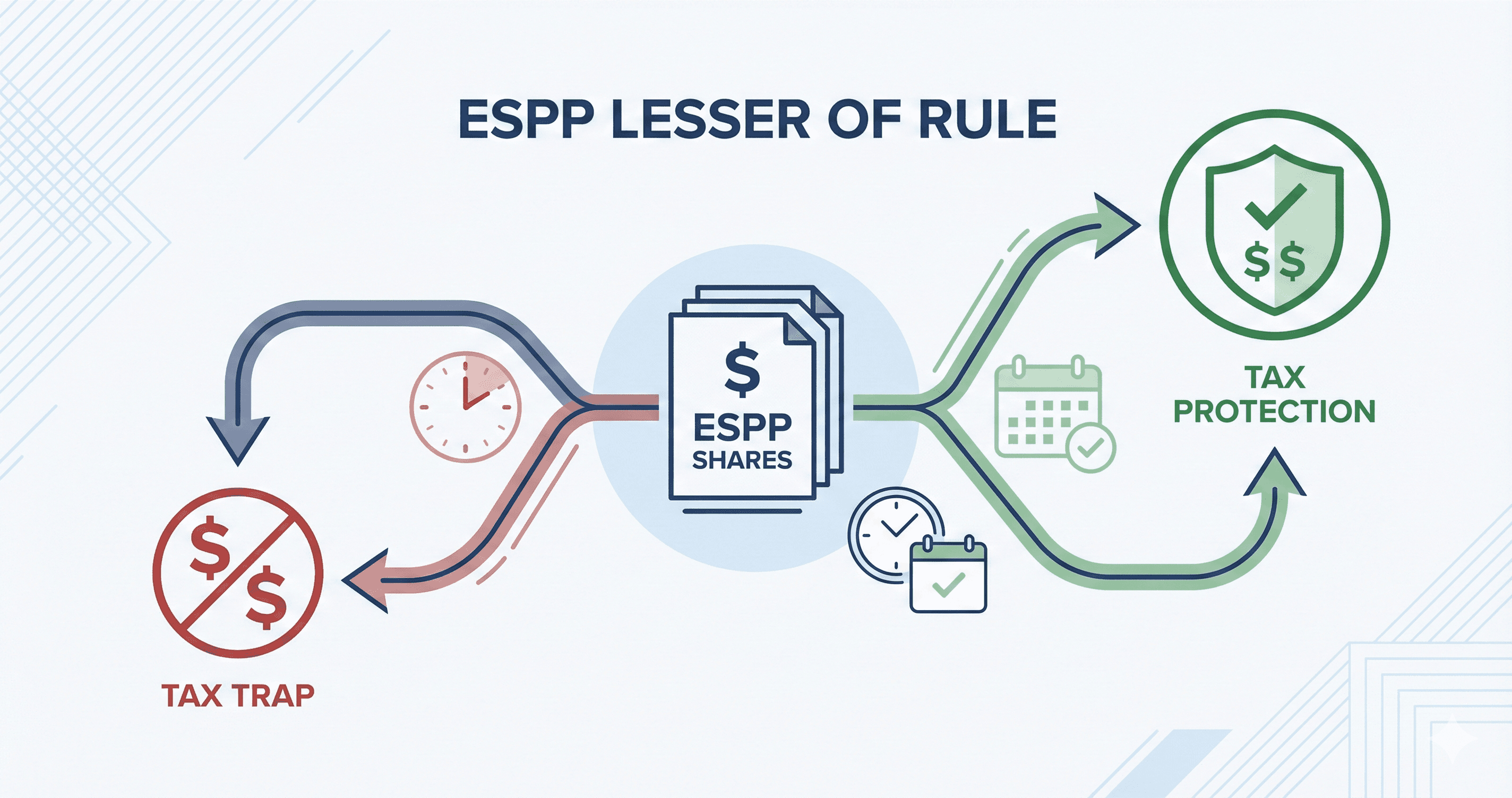
The ESPP 'Lesser Of' Rule Every Employee Should Understand
Why qualifying dispositions protect you from paying taxes on profits you never actually made
There’s a tax rule buried in ESPP regulations that most people—including many CPAs—get wrong. It’s the difference between paying taxes on money you never actually made and getting a “safety net” that protects you when stocks crash.
I’ve seen tech employees owe $3,000 in taxes on a $500 stock profit. I’ve also seen others save $8,000 in taxes on the same trade, simply because they understood one critical distinction.
The rule is called the “lesser of” provision for qualifying dispositions. And if you own ESPP shares, this might be the most important tax concept you never learned.
The Setup: When Your “Discount” Becomes a Tax Trap
Let me tell you the story of two employees who made the exact same ESPP trade—but one got crushed by taxes while the other walked away protected.
Both work at the same tech company. Both get a 15% discount. Here’s what happened:
The Promise (Grant Date):
Stock Price: $100
Promised Discount: 15%
Six Months Later (Purchase Date):
Stock Price: $120 (nice run-up!)
Their Purchase Price: $85 (15% off the original $100)
“Paper Profit” on Purchase Day: $35 per share
Both employees buy shares at $85. On that day, the shares are worth $120. They’re sitting on a $35 paper profit per share.
Then the stock market does what it always does: it humbles everyone.
The stock crashes to $90.
Employee #1: The Tax Nightmare (Disqualifying Disposition)
Employee #1 gets nervous about the crash and sells at $90 after holding for 18 months.
The Cash Reality:
Bought: $85
Sold: $90
Actual Profit: $5 per share
The Tax Reality: Because they broke the ESPP holding rules (less than 2 years from grant), the IRS treats this as compensation income based on the purchase date value.
Ordinary Income Tax: $35 per share (the full “bargain element” from purchase day)
Capital Loss: $30 per share ($90 sale price - $120 basis)
The Brutal Truth: Employee #1 made $5 in cash but owes income tax on $35. If they’re in a 35% tax bracket, they owe roughly $12 in federal taxes alone—plus state taxes. They literally owe more in taxes than they made in profit.
Yes, they can use the capital loss to offset other gains. But capital losses are limited to $3,000 per year against ordinary income. If you don’t have other capital gains to offset, you could be carrying this loss forward for years while you’ve already paid the tax bill.
Employee #2: The Safety Net (Qualifying Disposition)
Employee #2 holds through the same crash but waits until they hit the qualifying disposition thresholds (2+ years from grant, 1+ year from purchase). They sell at the same $90 price.
The Cash Reality:
Bought: $85
Sold: $90
Actual Profit: $5 per share
The Tax Reality: Because they followed the holding rules, the IRS applies the “lesser of” rule:
Pay ordinary income tax on the lesser of:
Your actual gain: $5
The original promised discount: $15 (15% of $100 grant price)
The Protection: Employee #2 pays ordinary income tax on just $5—the money they actually made.
The IRS essentially “forgets” about that $35 paper profit that evaporated. The tax bill matches reality.
But Wait—What If the Stock Had Skyrocketed?
Here’s where the story gets even more interesting. Let’s say both employees held through a boom instead of a crash. The stock rockets from $120 to $200.
Employee #1: Disqualifying Disposition at $200
The Cash:
Bought: $85, Sold: $200
Actual Profit: $115 per share
The Taxes:
Ordinary Income: $35 (still based on that $120 purchase day value)
Capital Gains: $80 ($200 - $120 basis)
Employee #2: Qualifying Disposition at $200
The Cash:
Bought: $85, Sold: $200
Actual Profit: $115 per share
The Taxes:
Ordinary Income: $15 (capped at the original promised discount)
Long-Term Capital Gains: $100 ($200 - $100 adjusted basis)
The Million-Dollar Question: Why Does This Matter?
By waiting for qualifying treatment, Employee #2 took $20 of profit (the growth from $100 to $120 during the offering period) and moved it from the high-tax bucket to the low-tax bucket.
If that $20 is taxed as ordinary income: ~37% federal + state taxes If that $20 is taxed as long-term capital gains: ~15-20% federal + state
On large positions, this difference can be thousands of dollars.
The Intuition: Why the Rules Work This Way
Think of it as a deal between you and the IRS:
Disqualifying (The “Flipper” Penalty): If you sell quickly, the IRS views this as pure compensation. Your company gave you stock worth $120 for $85. That $35 difference is essentially a cash bonus. The IRS wants their cut of that “bonus” immediately, regardless of what happens to the stock price later.
Qualifying (The “Investor” Reward): If you hold long-term, the IRS treats you as an investor who took real market risk.
When you lose money: They agree to tax you only on what you actually kept. The “compensation” element gets capped at your real gain.
When you make money: They agree that your “salary” portion was fixed on Day 1 (the original discount). Everything above that was earned through patience and investment risk, so it deserves the lower investment tax rate.
The Bottom Line
The ESPP “lesser of” rule for qualifying dispositions isn’t just a tax deferral strategy—it’s a fundamental protection that ensures you never pay taxes on profits you didn’t actually realize.
When stocks crash: Qualifying disposition caps your ordinary income at your actual gain, not some phantom paper profit that disappeared.
When stocks boom: Qualifying disposition caps your ordinary income at the original discount, letting the majority of your gains get taxed at lower capital gains rates.
The key insight: Time isn’t just money in the stock market. With ESPP shares, time literally changes your tax rate.
Before you sell those ESPP shares, make sure you understand which bucket your trade falls into. The difference could be worth thousands.
Understanding ESPP taxation requires navigating complex rules that even tax professionals sometimes miss. If you’re dealing with substantial ESPP positions, consider working with a specialist who focuses on equity compensation. The tax savings often far exceed the advisory fees.